
Daily Loss Limit: A Crypto and Forex Trader's Guide
- Discipline AI

- 7 days ago
- 8 min read

A daily loss limit (DLL) is a pre-set maximum loss threshold that stops all trading the moment it is reached in a single session. This rule is the single most effective capital preservation tool available to active traders. Industry guidelines place the standard DLL range at 1%–3% of account balance, with beginners advised to start at 2%. The DLL functions as a daily circuit breaker, cutting off trading before emotional decision-making and revenge trading destroy a week’s worth of gains in one bad afternoon.
What is a daily loss limit and why does it matter?
A daily loss limit is the fixed dollar amount or account percentage a trader agrees to lose before stopping all activity for the day. The moment that threshold is hit, trading ends. No exceptions, no renegotiation.
The primary purpose of a DLL is not just capital preservation. Its deeper function is to act as a circuit breaker on judgment, cutting off the spiral of revenge trading before it starts. Crypto and forex markets are open around the clock, which makes the temptation to “make it back” far more dangerous than in equity markets with fixed hours.
Without a DLL, a trader who loses 3% before noon often ends the day down 8% or more. The math compounds fast. A 10% account loss requires an 11.1% gain just to break even. A 25% loss requires a 33.3% gain. Protecting the downside is not defensive thinking. It is the foundation of long-term profitability.

How to set a daily loss limit that fits your account
The most common method ties the DLL directly to account balance as a percentage. Beginners should start at 2% and increase only after demonstrating consistent profitability over multiple months.
Calculating your DLL by account size
The math is straightforward. A $10,000 account with a 2% DLL means $200 is the maximum loss for the day. At 1% risk per trade, that allows two full losing trades before the session ends. A $5,000 account at 2% DLL caps losses at $100 per day. These numbers feel small until you realize they are what keeps the account alive through a losing streak.
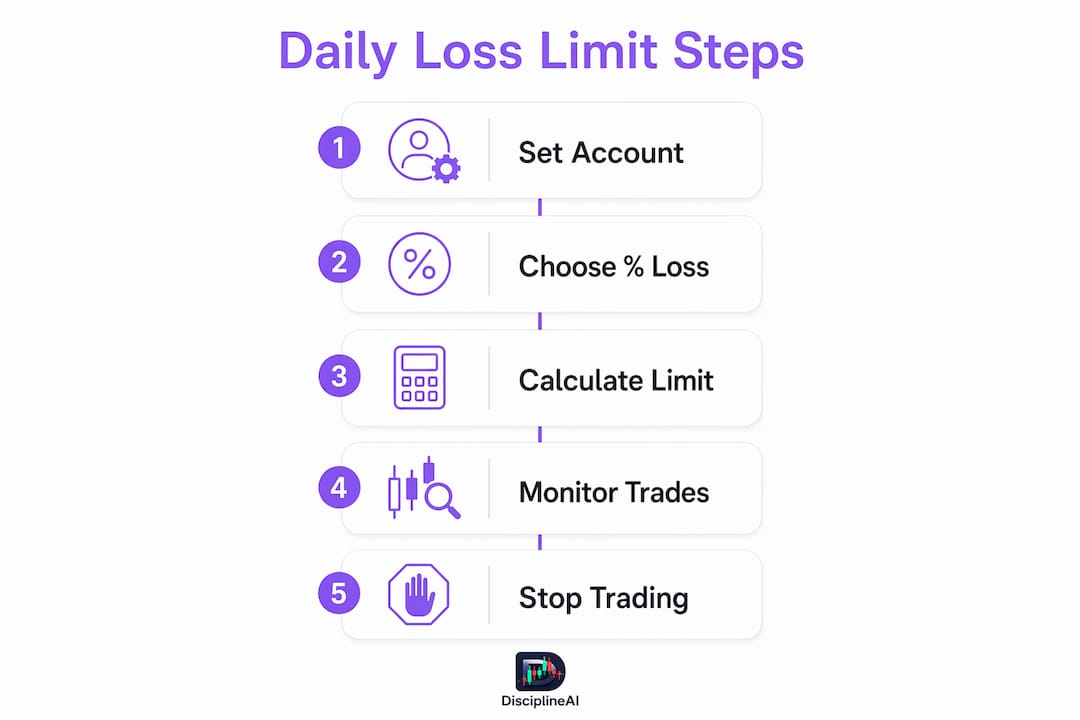
A second method ties the DLL to the average profit of winning days. If your average winning session nets $300, setting the DLL at $150 keeps the risk-to-reward ratio favorable across the week. This approach scales naturally with performance rather than just account size.
Key rules for setting your DLL:
Set the DLL before the market session opens, never during it
Express it as both a dollar amount and a percentage for clarity
Tie it to per-trade risk so position sizing stays consistent
Adjust DLL weekly or monthly as account equity changes, not mid-session
Document the number in your trading journal before placing the first trade
Pro Tip: Scale your DLL dynamically. If your account grows from $10,000 to $12,000, recalculate the 2% DLL to $240 at the start of the next week. Never raise the limit mid-session because of a recent win. That is how discipline breaks down.
The relationship between per-trade risk and the DLL is direct. Risking 1% per trade with a 3% DLL means three full losing trades end the session. This structure removes guesswork from position sizing and keeps every decision grounded in pre-set rules rather than real-time emotion.
Why does a daily loss limit improve trading psychology?
A DLL works as a behavioral guardrail, not just a financial one. Decisions made before the market opens are more rational and more likely to be followed than reactive adjustments made mid-session. Setting the DLL in a calm state locks in good judgment before adrenaline takes over.
Revenge trading is the most destructive pattern in active trading. After two or three consecutive losses, the brain shifts from analytical thinking to loss-aversion mode. Traders start sizing up positions to recover faster, abandoning their setups, and chasing price. A hard DLL stops this cycle before it accelerates.
“Tight DLLs force traders to walk away early, protecting mental focus and preventing emotionally driven risk-taking later. Tighter limits may provide greater psychological relief than looser ones by protecting the trader’s confidence during difficult days.”
The two-tiered system addresses this directly. A soft limit at 50%–75% of the hard DLL triggers a caution protocol: reduce position size, stop opening new setups, and reassess market conditions. The hard limit ends the session entirely.
Behaviors to adopt when hitting the hard DLL:
Close all open positions immediately
Shut down the trading platform
Write a brief journal entry covering what happened and why
Step away from screens for at least one hour
Return to review the session only after emotions have settled
Pro Tip: Pre-commitment is the key to DLL success. Tell a trading partner or accountability group your DLL before the session starts. External commitment makes it significantly harder to rationalize breaking the rule mid-day.
Post-DLL journaling supports learning and prevents emotional escalation. The goal is a calm, fact-based review later in the day, not immediate self-criticism or another attempt to trade back to breakeven.
Advanced daily loss limit strategies for crypto and forex traders
Professional traders use more nuanced frameworks than a simple percentage cap. These advanced methods protect profits, not just starting capital.
Loss-from-top DLL
The loss-from-top variant measures the maximum loss from the highest intraday equity peak rather than the opening balance. If a $10,000 account grows to $10,400 intraday and the DLL is 2%, the stop triggers at $10,192, not $9,800. This method protects profits earned during the session and tightens the drawdown ceiling as the day goes well.
R-based DLL limits
R-based limits tie the DLL to multiples of per-trade risk ®. If one R equals $100, a 3R DLL means the session ends after $300 in losses. This approach scales automatically with position sizing changes and keeps the DLL mathematically consistent regardless of account fluctuations.
Tiered DLL framework
Level | Threshold | Required action |
Soft limit | 50%–75% of hard DLL | Reduce position size, pause new entries |
Hard limit | 100% of DLL | Close all positions, end session |
Weekly cap | 5%–6% of account | No trading until next Monday |
Monthly cap | 10%–12% of account | Full strategy review before resuming |
Weekly and monthly caps prevent a single bad week from compounding into a catastrophic month. Crypto markets in particular can produce multi-day volatility clusters that destroy undisciplined accounts in days.
Advanced implementation steps for active traders:
Set the hard DLL as a broker-enforced kill switch where the platform automatically flattens positions and blocks new orders at the limit
Program a soft limit alert in your trading platform at 60% of the hard DLL
Define the R value for each session before placing the first trade
Apply the loss-from-top method during trending sessions to protect intraday profits
Log weekly and monthly drawdown totals in a separate risk register
A well-designed DLL scales automatically with equity changes to maintain consistent risk exposure as balances fluctuate. Static limits set once and never reviewed become misaligned with account reality within weeks.
How to implement and monitor your daily loss limit
Setting the DLL is step one. Tracking it accurately throughout the session is where most traders fail.
The cleanest approach counts realized and unrealized losses plus fees toward the DLL total. Ignoring open positions creates a false sense of safety. A trade sitting at a $150 unrealized loss on a $200 DLL account has $50 of room left, not $200.
Pre-session checklist for DLL implementation:
Calculate today’s DLL in dollars based on current account balance
Set a platform alert at the soft limit threshold
Confirm per-trade risk aligns with the DLL structure
Write the DLL number at the top of the day’s journal page
Request broker-side enforcement if the platform supports it
When the soft limit triggers, the behavioral protocol is clear: cut position size by half, stop entering new trades, and evaluate whether market conditions justify continuing at all. When the hard limit hits, the session ends. No exceptions.
Pro Tip: Use AI-based tools to monitor DLL proximity in real time. Platforms that track trading patterns with AI can alert you before emotions cloud your judgment, giving you a mechanical warning system that does not care how confident you feel about the next trade.
Avoid adjusting the DLL mid-session under any circumstances. A mechanical, non-negotiable DLL set before the market opens is the standard in professional risk management. Real-time adjustments based on emotion or recent performance are a sign of poor risk discipline, not flexibility.
Key Takeaways
A daily loss limit is the single most effective tool for preserving capital and maintaining trading discipline across volatile crypto and forex sessions.
Point | Details |
Standard DLL range | Set between 1%–3% of account balance; beginners should start at 2%. |
Two-tiered system | Use a soft limit at 50%–75% of the hard DLL to trigger caution before full shutdown. |
Loss-from-top method | Measure drawdown from the intraday equity peak to protect profits earned during the session. |
Count all losses | Include realized losses, unrealized losses, and fees to prevent loopholes in DLL tracking. |
No mid-session changes | Set the DLL before the market opens and treat it as non-negotiable for the entire session. |
The rule that separates surviving traders from the rest
Every trader I have watched blow up an account had one thing in common. They did not have a hard DLL, or they had one and ignored it the moment it became inconvenient. The second category is actually worse, because they knew the rule and chose to override it.
The traders who last years in crypto and forex are not necessarily the best analysts. They are the ones who treat the DLL as a hard stop, the same way a pilot treats a pre-flight checklist. You do not skip it because you feel confident today.
What I have seen consistently is that tighter DLLs build better traders faster. A 1% DLL feels suffocating at first. But it forces precision in setup selection, patience in execution, and honesty in journaling. Traders with loose or nonexistent limits tend to develop sloppy habits because the account absorbs the mistakes without consequence, until it does not.
The behavioral side is where most guides fall short. Hitting the DLL is not a failure. It is the system working exactly as designed. The traders who internalize that shift in perspective are the ones who come back the next session focused and ready, instead of demoralized or reckless. Pairing DLL discipline with stock trading best practices and AI-driven behavioral coaching closes the gap between knowing the rule and actually following it every day.
— Tony
How Disciplineaiapp supports your daily loss limit
Knowing your DLL and enforcing it are two different skills. Disciplineaiapp is built to close that gap for cryptocurrency traders who want data-driven discipline, not just good intentions.
Disciplineaiapp tracks your real-time P&L against your pre-set maximum daily loss, sends alerts as you approach the soft limit, and logs every session automatically in its integrated trade journal. The platform’s behavioral coaching flags emotional trading patterns before they escalate, and its AI trade autopsies review sessions where the DLL was approached or hit. Setup takes minutes, and the full feature set covers everything from confidence-scored trade setups to stand-aside protection on low-quality signals. For traders who want a system that enforces discipline mechanically, Disciplineaiapp removes the reliance on willpower alone.
FAQ
What is a daily loss limit in trading?
A daily loss limit is a pre-set maximum loss threshold that stops all trading for the session once reached. It protects capital and prevents emotional decision-making by acting as a hard daily circuit breaker.
What percentage should I set as my daily loss limit?
Industry guidelines recommend 1%–3% of account balance, with beginners starting at 2%. A $10,000 account at 2% DLL means a $200 maximum loss per day.
Should I count unrealized losses toward my daily loss limit?
Yes. The most effective DLL counts realized losses, unrealized open losses, and trading fees together. Ignoring open positions creates false headroom and undermines the limit’s purpose.
What is a soft limit in a daily loss limit framework?
A soft limit is set at 50%–75% of the hard DLL and triggers a caution protocol: reduce position size and stop entering new trades. The hard limit ends the session entirely.
Can I adjust my daily loss limit during a trading session?
No. A DLL must be set before the market opens and treated as non-negotiable for the entire session. Mid-session adjustments based on emotion or recent performance are a sign of poor risk discipline.
Recommended


Comments