
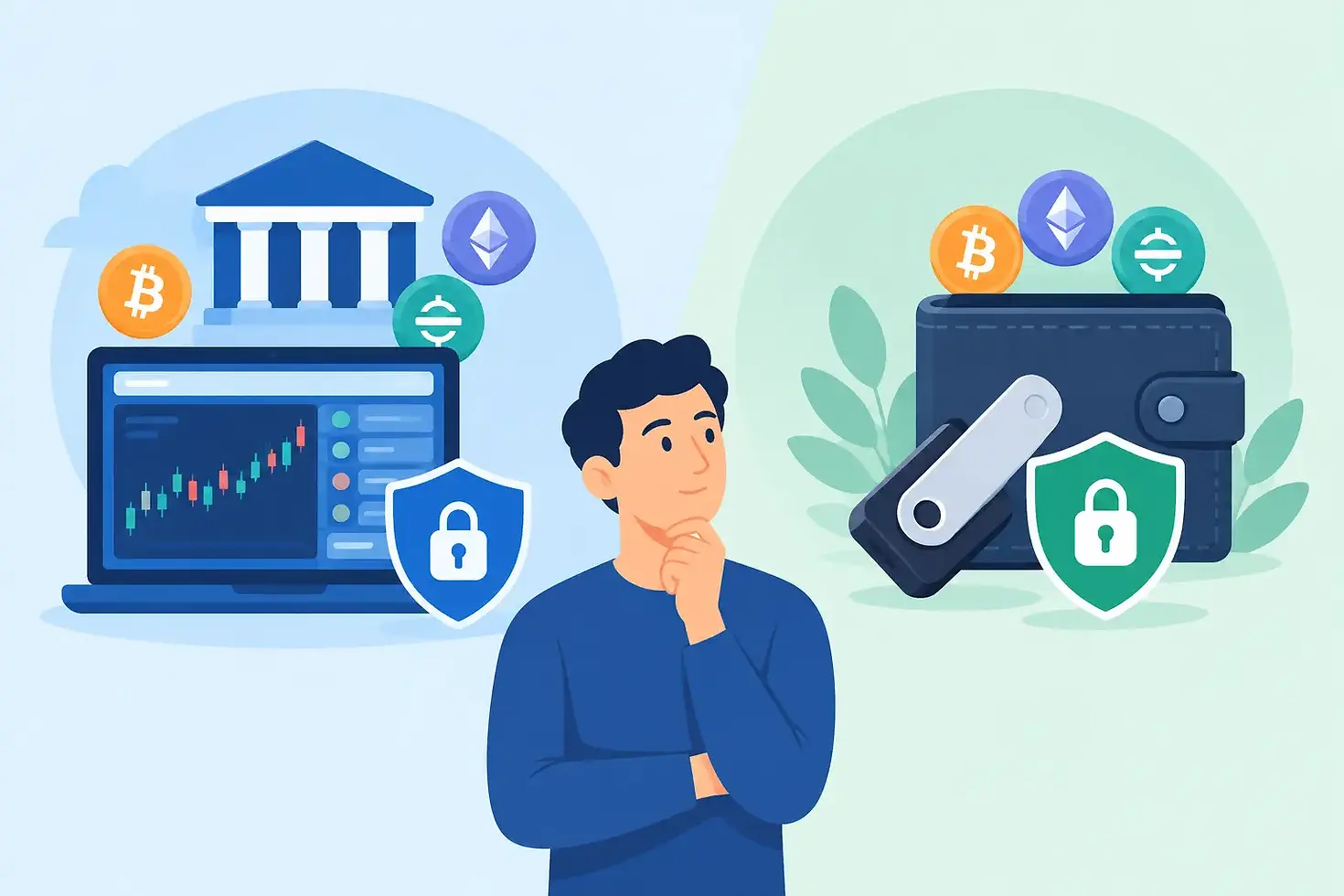
Exchange Versus Wallet Safety: What Beginners Need

Most beginners asking about exchange versus wallet safety are really asking one question: “Where is the safest place to keep my crypto?” The honest answer is that neither option is risk-free. An exchange is often easier to use and recover if you forget a password. A personal wallet gives you more control, but it also gives you more responsibility. The safer choice depends on what you own, how long you plan to hold it, and whether you can follow basic security steps consistently.
Exchange versus wallet safety: the simple difference
A crypto exchange is a company or app where you can buy, sell, and sometimes trade crypto. Think of it like using a financial platform that holds assets for you. When your crypto stays on the exchange, the exchange usually controls the private keys.
A private key is the secret proof that allows crypto to be moved. You do not need to understand the code behind it. Just remember this: whoever controls the private key controls the crypto.
A wallet is a tool that stores or manages those keys. With a personal wallet, you usually control the private key yourself. This is called self-custody. It means you are not relying on an exchange to approve or protect every withdrawal.
Here is a coffee-money example. Imagine you buy $50 of Bitcoin. Leaving it on an exchange is a bit like keeping money in an account managed by a company. Moving it to your own wallet is more like carrying the only key to a locked cash box. The company cannot freeze the box, but if you lose the key, there may be nobody who can open it for you.
Is an exchange safe enough for beginners?
For a small amount of crypto, a well-known exchange can be a practical starting point. It may have password recovery, identity checks, fraud monitoring, and customer support. Those features can reduce the chance that one forgotten password ends your experience.
But convenience is not the same as zero risk. An exchange can be targeted by hackers. Your account can be taken over if someone gets your email password or tricks you with a fake login page. The company can also pause withdrawals during technical problems or unusual market conditions. In extreme cases, an exchange can fail financially.
This does not mean every exchange is unsafe. It means you should understand the trade-off: when crypto stays on an exchange, you are trusting that business to safeguard access and remain operational.
For someone learning with a small amount, that trade-off may be reasonable. For someone holding money they cannot afford to lose, it deserves more thought. Crypto is not a savings account, and a platform name alone is not a safety plan.
How to make an exchange account safer
Start with a unique, long password that you do not use anywhere else. If your email account is weak, your exchange account is weak too, because email is often used for password resets.
Turn on two-factor authentication, often called 2FA. This adds a second proof when you log in, such as a code from an authentication app. An authentication app is generally safer than receiving login codes by text message, because phone numbers can sometimes be hijacked.
Be suspicious of messages that create urgency. A scammer may say your account will be locked, your funds are at risk, or you need to “verify” a withdrawal. Do not use a link in that message. Open the official app yourself and check there.
Also, do not keep a large balance on an exchange simply because you may want to trade someday. A plan is better: keep only the amount you have decided to use for a specific purpose.
Are personal wallets safer?
A personal wallet can reduce one major risk: dependence on an exchange. If you control your own keys, an exchange problem does not automatically block access to your crypto.
However, self-custody creates different risks. There is no password-reset desk for a lost recovery phrase. A recovery phrase, sometimes called a seed phrase, is a list of words that can restore your wallet. Anyone with that phrase can usually take the funds. If you lose it and your device fails, you may lose access permanently.
Personal wallets also do not protect you from bad decisions. You can still send crypto to the wrong address, approve a scam transaction, or connect your wallet to a fake website. Unlike a bank transfer, crypto transactions are often hard or impossible to reverse.
So, is a wallet safer? It can be, especially for long-term storage, but only if you can handle the responsibility. Control is useful only when it comes with careful habits.
Software wallets and hardware wallets
A software wallet is an app on a phone or computer. It is convenient, but the device needs to be kept secure. Use screen locks, software updates, and downloads from official app stores or verified sources.
A hardware wallet is a small physical device designed to keep private keys offline. “Offline” means the key is less exposed while you browse the web or use your computer. This can add protection for larger long-term holdings, but it does not make you immune to scams. If you enter your recovery phrase into a fake site or share it with someone, the hardware wallet cannot save you.
Never share a recovery phrase with customer support, a friend, a social media account, or anyone claiming to help recover funds. Legitimate support should not need it.
Choose based on your situation, not fear
Many beginners treat this as an all-or-nothing choice. It does not have to be. You can use an exchange to learn how buying and selling works, while deciding later whether self-custody fits your needs.
If you are buying a small amount to learn, an exchange with strong account security may be simpler. If you plan to hold a meaningful amount for a long time and are willing to learn recovery-phrase safety, a personal wallet may make more sense. If losing the amount would cause financial stress, the first step may be to reduce the amount rather than search for a perfect storage method.
Your behavior matters as much as the tool. Someone who carefully protects a recovery phrase may be safer with a wallet than someone who clicks every urgent message. Someone who uses unique passwords and 2FA may be safer on an exchange than someone who stores a seed phrase in a phone screenshot.
A beginner safety routine
Before you buy crypto, write down what you will do if you lose your phone, forget your password, or receive a suspicious message. This sounds boring. It is also the kind of preparation that prevents expensive mistakes.
Use a small test transaction before moving a larger amount to a new wallet. For example, if you want to send $100, send $5 first, confirm it arrives, then send the rest. Check the receiving address carefully. One wrong character can send funds somewhere you cannot recover.
Do not rush because a price is moving. FOMO, or fear of missing out, pushes people to skip checks. Scammers and volatile markets both benefit when you act fast without a process.
Keep your trading funds separate from money you need for rent, food, bills, or emergencies. If you decide to trade, understand that trading involves risk of loss. A chart shows past price movement, not a promise about what happens next.
Discipline AI can help beginners practice trading decisions with fake money before using real money. Paper trading means placing practice trades without risking cash. It will not teach wallet security by itself, but it can help you separate the skill of trading from the decision to move real funds.
FAQ
Should I keep all my crypto on an exchange?
Not automatically. An exchange may be convenient for small balances and active use, but keeping everything in one place concentrates risk. Decide how much you need accessible and how much responsibility you can manage safely.
Can an exchange take my crypto?
An exchange controls the custody of crypto held on its platform, subject to its rules, security systems, and legal requirements. That is why reading its security options and understanding withdrawal access matters.
What happens if I lose my wallet recovery phrase?
If you also lose access to the wallet device or app, you may be unable to recover the crypto. Store the phrase offline in a secure place, and never photograph, email, or share it.
Is a hardware wallet necessary for $50 of crypto?
Usually, it may be more complexity than a beginner needs. Start by learning the risks and securing your exchange account. Reconsider as your balance and confidence grow.
Education only; trading involves risk of loss and this is not financial advice. Choose the setup you understand well enough to protect, then practice this idea with fake money first.
Comments