
Liquidity Sweep Trading: Strategies for Smarter Entries


Liquidity sweep trading is the practice of capitalizing on price moves that temporarily extend beyond key liquidity zones to trigger clustered stop-loss orders, allowing large traders to fill significant positions efficiently. This concept sits at the heart of smart money concepts and market structure trading, where understanding why price moves matters as much as knowing where it moves. Retail traders who misread these moves get stopped out repeatedly. Those who understand the mechanics trade alongside institutional order flow instead of against it. Liquidity sweep trading is not manipulation. It is the market doing exactly what it must to match large buyers with large sellers.
What is liquidity sweep trading and how does it work?
A liquidity sweep is defined as a deliberate price extension beyond a key structural level, such as equal highs, equal lows, or prior swing points, where stop-loss orders accumulate in clusters. The sweep triggers those stops, generating the order flow that institutions need to fill large positions without excessive slippage. Once the liquidity is absorbed, price typically reverses or continues with renewed momentum.
The term “liquidity sweep” is the standard industry phrase used in smart money concepts and institutional order flow analysis. Traders also encounter related terms like stop hunt trading and liquidity grab trading, which describe overlapping but distinct behaviors. All three describe price reaching into areas where retail stops are concentrated. The difference lies in speed, intent, and what follows the move.

Institutional order execution treats these events as microstructure mechanics, not manipulation. A fund managing hundreds of millions of dollars cannot simply place a market order and expect clean execution. It needs counterparty volume. Stop-loss clusters at obvious price levels provide exactly that volume.
Pro Tip: Mark equal highs and equal lows on your chart every session. These are the most common liquidity pool targets for sweeps.
How do liquidity sweeps differ from liquidity grabs?
Traders frequently confuse liquidity sweeps with liquidity grabs. The distinction matters because each pattern calls for a different response.
A liquidity grab vs. liquidity sweep comparison reveals clear structural differences. A grab is aggressive: price spikes sharply through a level in one or two candles and reverses almost immediately. A sweep is methodical: price works through a zone over several candles, clearing liquidity gradually before showing directional intent. Grabs signal reversal setups. Sweeps can signal either reversal or continuation depending on context.
Feature | Liquidity Grab | Liquidity Sweep |
Speed | Fast, 1–2 candles | Gradual, multiple candles |
Intent | Reversal oriented | Reversal or continuation |
Candle structure | Sharp wick, quick close | Sustained push through level |
Trader response | Immediate reversal entry | Wait for structure confirmation |
Risk profile | Higher false signal rate | Lower when confirmed properly |
The practical takeaway is straightforward. A grab demands speed and a tight entry near the wick. A sweep demands patience and a confirmed structure break before entry. Mixing up the two is one of the most common reasons traders enter too early and get caught in a second sweep.
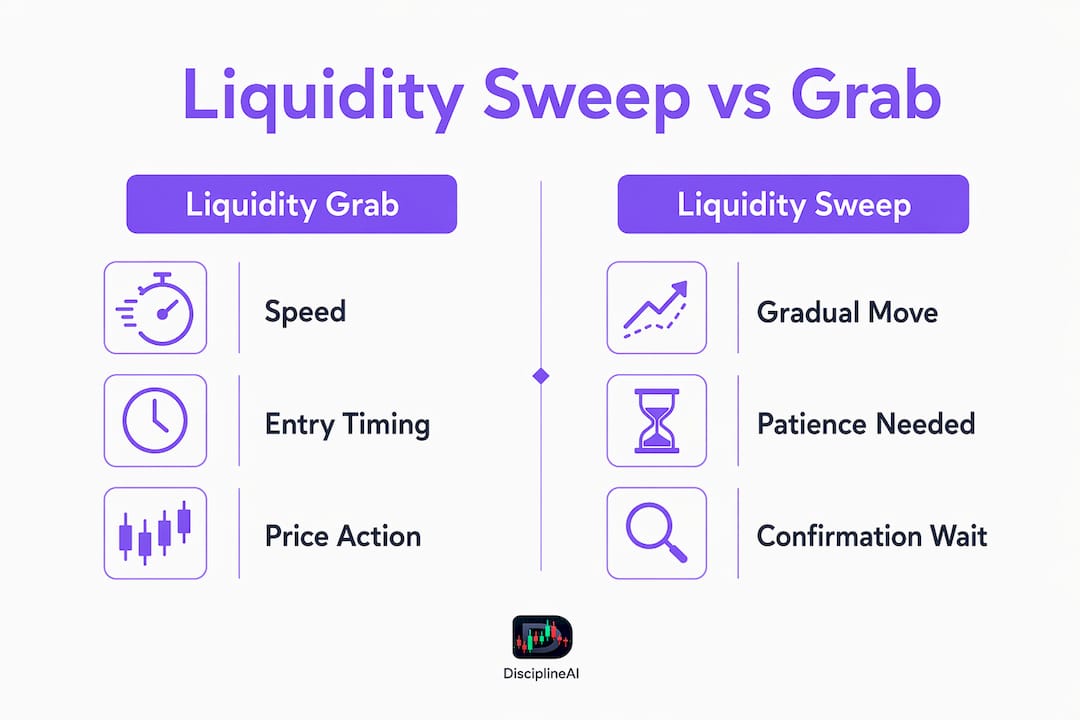
Differentiating between a liquidity grab and a liquidity sweep is the foundation of applying the correct sweep trading strategies for each scenario. Treating every spike as a grab leads to premature entries. Treating every sweep as a grab leads to missed reversals.
How do institutional traders use liquidity sweeps in execution?
Large institutional orders depend on sweeping liquidity around equal highs, equal lows, and other stop clusters to fill sizable positions efficiently. Repeated price touches at the same level create dense liquidity pools that become obvious targets during sweep events. The more obvious the level, the more stops accumulate there, and the more attractive it becomes for institutional execution.
The sequence follows a consistent pattern:
Price approaches a well-defined structural level, such as a prior week’s high or a series of equal lows.
Retail traders place stop-loss orders just beyond that level, following standard technical analysis practice.
Price extends through the level, triggering those stops and generating a surge of market orders.
Institutions absorb that order flow to build or exit positions at favorable prices.
Price reverses or accelerates in the intended institutional direction.
This process is not unique to any single market. It occurs in crypto, forex, equities, and futures. The behavior is a direct consequence of how large orders interact with available liquidity in any order-driven market.
“Liquidity sweeps are microstructure mechanics where institutions clear liquidity pools at retail stop-loss clusters for efficient order execution. This is not manipulation but a necessary function of order flow to fill large positions without excessive slippage.”
Understanding this sequence changes how you read price action. A sudden push through a key level is no longer a random spike. It is a signal that institutional players are actively working an order. The question becomes: are they buying or selling into that liquidity? Volume analysis and the subsequent price behavior answer that question.
AI pattern detection systems now identify these institutional footprints in real time, flagging sweep events across multiple timeframes before the reversal fully develops.
What are effective liquidity sweep trading strategies?
Effective liquidity sweep trading requires three things: identifying the right levels, waiting for confirmation, and managing risk with discipline.
Identifying high-probability sweep targets
Buy side liquidity sits above swing highs, equal highs, and prior resistance levels where short sellers place their stops. Sell side liquidity sits below swing lows, equal lows, and prior support levels where long traders place their stops. The highest-probability sweep targets are levels that have been tested multiple times without breaking, as each test adds more stop orders to the cluster.
Multi-timeframe analysis sharpens target selection. Identify the liquidity pool on the daily or 4-hour chart, then drop to the 15-minute or 5-minute chart to watch the sweep develop in real time.
Entry confirmation after the sweep
Waiting for 1–3 candles to confirm a reversal or market structure break on 1–5 minute timeframes avoids the “double-sweep” trap prevalent in automated markets. A Market Structure Shift (MSS) or Change of Character (CHoCH) on a lower timeframe confirms that the sweep is complete and institutional absorption has occurred.
The steps for a confirmed entry are:
Mark the liquidity pool on a higher timeframe chart.
Wait for price to sweep through the level with a clear wick or sustained push.
Watch for a Market Structure Shift on the 1-minute to 5-minute chart.
Enter after the first pullback following the structure break.
Place your stop beyond the sweep wick with a buffer.
Stop placement and risk management
Stop-loss placement 2–5 pips or 1.5x ATR beyond structural levels reduces the risk of premature stop triggering by secondary sweeps. Placing a stop exactly at the wick low or high is the most common mistake. Price frequently retests the swept level before moving in the intended direction.
Traders should limit exposure to 1–2% of account capital per trade, with reward-to-risk ratios targeting 2:1 to 3:1. Those numbers exist for a reason. A 2:1 ratio means you can be wrong 40% of the time and still profit. Combined with crypto risk management practices, this framework keeps losses contained while allowing winners to run.
Pro Tip: Never enter directly on the sweep wick. Wait for the structure break. You will miss the exact low or high, but you will avoid the majority of false signals.
Common misconceptions about liquidity sweeps
The biggest misconception in stop hunt trading is that brokers deliberately move price to trigger retail stops. Stop hunting is a natural consequence of market liquidity needs, not broker manipulation. Retail traders cluster their stops at the same obvious levels because they follow the same technical analysis rules. That clustering creates the liquidity that institutions need. The result looks like targeting, but it is simply supply and demand at the microstructure level.
Several other misconceptions create consistent trading errors:
Entering on the wick: The sweep wick is not an entry signal. It is the event itself. Entering before confirmation means trading against the sweep, not with it.
Assuming every sweep reverses: Sweeps in trending markets often lead to continuation, not reversal. Context determines direction.
Blaming the broker: Comparing price data across multiple providers distinguishes genuine sweeps from data anomalies. If the spike appears on all feeds, it is real market activity.
Ignoring volume: A sweep without elevated volume is a weak signal. Volume confirms that institutional absorption actually occurred.
Trading every sweep: Not every liquidity pool produces a traceable setup. High-probability setups require confluence: the right level, the right timeframe, and confirmed structure.
The “double sweep” is a specific trap worth understanding separately. Price sweeps a level, appears to reverse, then sweeps the same level again before the real move begins. Waiting for confirmation after the sweep, rather than entering on the first reversal candle, protects against this pattern. Automated trading systems are particularly prone to triggering double sweeps because they react to the first sweep mechanically.
Pro Tip: If a level has already been swept once and price returns to it, treat the second approach as a potential double sweep. Widen your stop or wait for stronger confirmation before entering.
Key Takeaways
Liquidity sweep trading works because institutional order flow requires stop-loss clusters as counterparty volume, and traders who wait for confirmed structure breaks after sweeps trade with that flow rather than against it.
Point | Details |
Sweeps vs. grabs | Grabs are fast reversals; sweeps are gradual and require confirmation before entry. |
Institutional mechanics | Large orders need stop clusters to fill positions efficiently without excessive slippage. |
Entry confirmation | Wait for a Market Structure Shift on 1–5 minute charts before entering after a sweep. |
Risk management | Limit risk to 1–2% per trade and target 2:1 to 3:1 reward-to-risk on every setup. |
Stop placement | Place stops 1.5x ATR beyond the sweep wick to survive secondary retests. |
Why patience is the real edge in sweep trading
Most traders who study liquidity sweeps understand the concept within a few weeks. The ones who actually profit from it consistently share one trait: they wait. The temptation to enter on the wick is almost irresistible. Price is moving fast, the level is obvious, and the reversal looks imminent. But the wick entry is where retail traders get caught, and the confirmation entry is where institutional volume starts flowing in your direction.
I have found that the traders who struggle most with sweep setups are not struggling with analysis. They are struggling with execution discipline. They identify the right level, watch the sweep happen, and then enter one candle too early because they fear missing the move. The result is a stop-out followed by watching the trade work perfectly from their entry point.
The solution is not a better indicator or a faster data feed. It is a written rule: no entry without a confirmed structure break on the lower timeframe. That rule, applied consistently, eliminates the majority of false entries. Pair it with a trading accountability system that forces you to review every sweep trade, and the pattern of early entries disappears within a month.
Liquidity sweep trading is one of the few strategies where doing less, waiting longer, and accepting a slightly worse entry price actually produces better results. The market rewards patience here in a way it rarely does elsewhere.
— Tony
Disciplineaiapp and liquidity sweep analysis
Identifying liquidity pools and confirming sweep events manually across multiple timeframes takes significant time and focus. Disciplineaiapp is built to support exactly this kind of analysis for cryptocurrency traders.
The platform’s intelligence engine analyzes market structure, liquidity events, and volume conditions across assets and timeframes to flag potential sweep setups with AI-generated confidence scores. Traders receive execution guidance, behavioral coaching, and AI trade autopsies that show exactly where entries, stops, and targets could have been improved. The AI Learning Center covers smart money concepts and liquidity pattern recognition in depth. For traders who want data-driven support on every sweep setup, the full platform features are worth exploring.
FAQ
What is a liquidity sweep in trading?
A liquidity sweep is a price move that extends beyond a key structural level to trigger clustered stop-loss orders, providing institutional traders with the order flow needed to fill large positions efficiently.
How is a liquidity sweep different from a stop hunt?
Stop hunt is an informal term for the same event. The difference is framing: stop hunt implies deliberate manipulation, while liquidity sweep describes the natural microstructure mechanic that drives the move.
When should I enter a trade after a liquidity sweep?
Enter after 1–3 candles confirm a Market Structure Shift or Change of Character on a 1–5 minute timeframe. Entering directly on the sweep wick significantly increases false signal risk.
What risk limits apply to liquidity sweep trades?
Limit exposure to 1–2% of account capital per trade and target reward-to-risk ratios of 2:1 to 3:1. Place stops 1.5x ATR beyond the sweep wick to avoid premature stop triggering.
Do liquidity sweeps always lead to reversals?
No. Sweeps in strong trending markets frequently lead to continuation rather than reversal. Always assess the broader market structure and volume before assuming a sweep signals a directional change.
Recommended

Comments