
Verify Trading Signals for Traders: Under 3 Minutes, Then Falsify


Only act on a signal that includes all seven required elements. If asset, direction, entry zone, stop-loss, take-profit, timeframe, and invalidation aren’t all spelled out, skip it. From there, run a quick technical confirmation and a position-sizing check before anything else. Some trading platforms build this layered logic in directly, scoring setups by confidence and running validation before a trade ever reaches you.
TL;DR:
Most traders only verify the completeness of a signal rather than checking for an actual statistical edge or current market alignment, increasing risk of false setups.
Reliable signals must include seven key elements, especially explicit stop-loss and invalidation conditions, to allow proper sizing, backtesting, and future evaluation.
Running a quick technical check on multiple timeframes, volume, spread, and confluence can identify undesirable setups within three minutes before placement.
Proper risk control involves matching position size to risk rules, ensuring minimum reward ratios, and avoiding trades that fail to meet these criteria.
Independent validation tools and platform-assisted scoring, like AI-confidence metrics, help reduce manipulation and improve trustworthiness of signals before trading real money.
Table of Contents
What Does It Mean to Verify a Trading Signal?
To verify a trading signal, you check that it contains every required field, then confirm it against current price action, and finally test whether the underlying rule has any statistical edge at all. That’s three separate gates, and most traders only ever run the first one, if they run any at all.
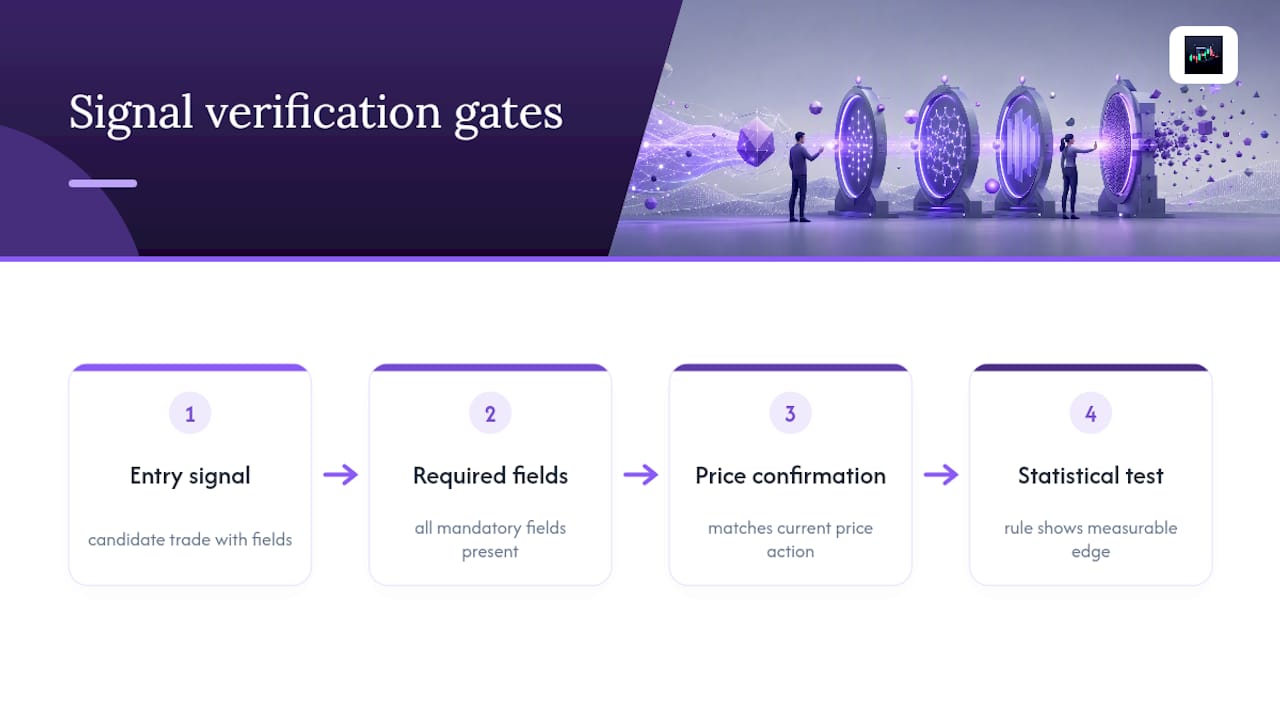
The industry term for this is signal confirmation, and it’s distinct from just “liking” a setup because it matches your gut feeling. A confirmed signal has survived a structured check. An unconfirmed one is a guess with a chart attached.
What A Complete Trading Signal Must Include
A signal isn’t evaluable unless it answers seven specific questions. Miss any one of them and you can’t size the trade, can’t automate a backtest against it, and can’t tell later whether it actually worked.
Asset/symbol: The exact instrument, not “crypto is pumping” or “watch gold.”
Direction: Buy or sell, long or short, stated without ambiguity.
Entry zone: A price or tight range, not a vague “buy the dip.”
Stop-loss: The exact price where the thesis is proven wrong.
Take-profit target(s): Where you exit for a win, ideally with more than one level.
Timeframe: The chart the signal was generated on, since a 15-minute breakout and a daily breakout are different trades entirely.
Invalidation or expiry: The condition or time window after which the signal no longer applies.
Here’s the contrast in practice. “BTC looking bullish, might break out soon” gives you nothing to act on and nothing to verify later. Compare that to: “BTC/USD, long, entry $61,200 to $61,600, stop $60,400, target $63,800, 4-hour chart, invalid if price closes below $60,000 before entry triggers.” That second version can be simulated, sized, and graded after the fact. The first one can only be argued about.
Providers who consistently omit the stop-loss or the invalidation condition are worth noticing. Both fields expose them to being proven wrong, and their absence is often not an accident.
Fast Technical Confirmations You Can Run in Under Three Minutes
Before you touch position sizing, run this checklist against the chart yourself. It won’t tell you if the signal has a statistical edge, but it will catch a huge share of bad setups fast.
Check trend and structure on two timeframes. Look at the signal’s own timeframe and one step higher. A long signal fighting a clear downtrend on the higher timeframe carries more risk than the signal alone suggests.
Confirm volume and spread support the move. A breakout on thin volume, or a spread that eats a third of your stop distance, is a red flag regardless of how clean the setup looks.
Look for confluence. Does the entry zone line up with a real support or resistance level, a moving average, or a shift in momentum? One indicator agreeing with the signal is nice. Three disagreeing with it is a reason to pass.
Verify timeframe alignment. If the 4 hour chart says buy and the daily chart says the trend just broke down, that mismatch is exactly the kind of noise that produces false positives.
Trading guides consistently recommend pairing any external signal with your own read of the chart rather than accepting it blind, and testing unfamiliar providers on a demo account before committing real funds.
Pro Tip: Run the higher timeframe check first. If the broader trend contradicts the signal, you can skip steps two through four entirely and save yourself two minutes.
Risk Controls to Check Before You Commit Capital
Verification isn’t finished until you’ve translated the signal into a position size and confirmed it fits inside your risk rules. A technically perfect signal with the wrong size behind it is still a bad trade.
Position size comes from three numbers: account risk percentage, stop distance, and account size. Change the stop distance and the position size moves with it. This is why a signal without a defined stop can’t be sized responsibly at all.
Set a minimum risk to reward ratio, generally 1.5 to 1 or higher, before you’ll consider the trade.
Accept a lower ratio only when the edge has been statistically validated elsewhere, since a proven edge can carry more trades at breakeven or slightly negative individual reward.
Cap your maximum daily loss at a fixed percentage of the account, so one bad signal or one bad day can’t compound into a bad month.
Cap concurrent exposure across correlated positions, since three “different” signals on correlated crypto pairs behave like one oversized bet.
If any of these checks fails, the fix isn’t to trade smaller. It’s to not take the trade.
How to Verify a Signal Source’s Reliability and Detect Manipulation
Fraudulent or exaggerated signal providers remain a real problem for retail traders, and independent verification is often the only defense against inflated claims. Before trusting a provider with real capital, demand proof that would hold up if someone else tried to check it.
Trustworthy evidence looks specific: a timestamped export of every signal sent, a raw trade list including fills and fees, and a full history rather than a curated highlight reel. A provider who only shows you their best month, or who can’t produce a timestamped log at all, hasn’t given you evidence. They’ve given you marketing.
Manipulation is usually detectable if you know where to look:
Compare posted timestamps against the actual market move. A signal posted “before” a breakout that, on closer inspection, was edited after the fact is a common trick.
Check for edited or deleted messages in the channel or group history, since a legitimate signal shouldn’t need retroactive cleanup.
Watch for sample sizes too small to mean anything, and weight recent signals more heavily than old ones, since market conditions shift and a provider’s edge from two years ago may no longer exist.
AI-driven forensic pipelines now exist specifically to catch this kind of manipulation, pulling raw channel messages, fetching minute-level market data, and simulating fills candle by candle to compute a trust score. One such system reports verifying signal providers with 94% accuracy using exactly this method.
The minimum bar: if a provider can’t produce a raw, timestamped, unedited trade log covering at least several dozen signals, treat every claim they make as unverified.
Validate Signals Without Risking Real Money
Confidence in a signal source should be earned in stages, not assumed on day one. The sequence matters more than any single test in isolation.
Run a rule-only prefilter. Record what the entry rule would have triggered historically and check the next-bar return, before you bother with a full strategy backtest. This signal-only test is faster and catches obviously dead rules early, using the same detrended bootstrap approach documented in quantitative trading research.
Backtest with realistic costs. Include spread, slippage, and fees, not just theoretical entries and exits. A strategy that only wins with zero costs isn’t a strategy.
Run a walk-forward or forward test. Test on data the rule wasn’t built on, ideally moving forward through time rather than testing everything at once.
Demo or paper trade the signal live. Watch it perform in real time conditions with no money at risk, and don’t stop at five or ten trades. Aim for a sample large enough to mean something, generally several dozen signals minimum.
Scale in gradually. Once demo results look solid, move to small live size before committing full position sizes.
Skipping straight from “the signal looks good” to full-size live trading is how traders discover, expensively, that a chart pattern and an edge are not the same thing.
Statistical and Adversarial Validation Methods Every Trader Should Know
Technical checks and demo testing catch obvious problems. They don’t catch the subtler ones, which is where statistical and adversarial validation come in.
Rule significance testing isolates whether an entry rule has real predictive power, separate from the rest of the strategy. The method records every signal and its next-bar return, det rends those returns to remove market drift, then runs bootstrap simulations to generate a p-value for the result. A rule that can’t clear this bar has no business being backtested further.
Beyond that, a full adversarial battery tries specifically to prove a backtest is noise:
Lookahead detection, checked by re-running the signal on truncated history and confirming past decisions don’t change. Even one bar of lookahead invalidates the entire result.
Cost breakeven testing, which checks whether realistic fees and slippage erase the apparent edge entirely.
Deflated Sharpe or family-wise deflation, which accounts for the fact that testing many parameter combinations makes a lucky result look skilled.
Permutation and placebo tests, which shuffle the data to see if random noise produces similar results.
Regime splits and universe checks, which test whether the edge holds across different market conditions or only in the one you happened to pick.
Toolkits built specifically for this, like the open source falsify adversarial validation framework, run these tests systematically rather than leaving traders to eyeball a single equity curve. Independent services such as AlphaAssay’s validator go a step further, returning a deterministic pass or fail verdict with specific failure codes when a signal doesn’t clear the bar.
A pass on adversarial tests means the result survived specific attempts to prove it was noise. It does not mean the strategy will be profitable going forward, and it still needs to be paired with realistic cost modeling before you trust it with capital.
Pre-Trade Final Check: The Instant Checklist at Order Entry
Everything above happens before you’re staring at the order ticket. This last check happens in the sixty seconds before you click buy or sell, because markets move and signals go stale.
Re-confirm all seven elements are still accurate. Has price already blown past the entry zone? Is the stop still a sensible distance away?
Recompute position size using the current price, not the price when the signal was issued.
Check the live spread and available liquidity, especially for less liquid crypto pairs or after-hours stock trades.
Confirm your stop and take-profit orders are actually set, not just planned in your head.
If anything fails this check, skip the trade and write down why. That single line in your journal is often the most valuable data point you’ll produce all week.
Pro Tip: If you find yourself rationalizing a failed re-check (“the spread’s a little wide but it should be fine”), that’s usually the moment to walk away. The urge to override your own rule is the tell.
Publisher Perspective: Why Falsification Beats Confirmation
Most traders verify signals to feel better about a decision they’ve already made. That’s backwards. Verification should try to break the signal, not support it. If a setup survives an honest attempt to prove it doesn’t work, it’s earned your capital. If it only survives a friendly glance, it hasn’t.
That’s the standard we hold ourselves to. Discipline AI’s intelligence engine is built to suppress low-confidence setups rather than generate a constant stream of them, and every setup carries a confidence score along with transparent calibration data so you can see how prior signals actually performed, not just how they were described. Trade logs and outcome tracking exist so the record can be checked, not just claimed.
Where does platform-assisted verification end and manual checking begin? Use the platform for the heavy statistical lifting, the sample sizes, the calibration history, the pattern recognition across timeframes. Use your own judgment for context a model can miss: news events, illiquid conditions, or a market that’s simply behaving strangely today. Neither replaces the other.
— Tony
How Discipline AI Helps You Verify Signals Before You Trade
Most of the verification work in this article, the seven-element check, the technical confirmation, the position sizing, the confidence scoring, is exactly what Discipline AI builds into the platform itself, instead of leaving it to you to run manually every time a signal lands.

Many AI-generated trade setups include a confidence score and execution guidance, often backed by calibration data showing past setup performance rather than just claims. It typically incorporates market structure analysis, multi-timeframe alignment, position sizing, and trade journaling, helping to automate discipline rather than relying solely on user memory under pressure. Discipline AI’s Pro plan runs $8.99 a month, $79.99 billed yearly, or $199.99 as a one-time payment, and if you want a structured, one-time program to build the habits behind all of this, The Disciplined Trader is available for $79. Check the pricing page to see which option fits how you trade.
Sources
For deeper method study, Jesse’s rule significance testing documentation explains the statistical procedure itself. The falsify toolkit is best used as an adversarial validation library you can run against your own backtests. AlphaAssay’s validator suits traders who want an independent, structured pass or fail verdict rather than self-grading their own results.
FAQ
How Do You Identify a Legitimate Trading Signal?
A legitimate signal always includes all seven core elements: asset, direction, entry zone, stop-loss, take-profit, timeframe, and invalidation condition. If a provider consistently omits the stop-loss or gives vague entries like “buy the dip,” treat that as a warning sign rather than a style choice.
Can ChatGPT Give Reliable Trading Signals?
General-purpose AI chat tools can describe technical concepts and summarize patterns, but they aren’t built to run live market data, backtest historical performance, or generate calibrated confidence scores. Purpose-built platforms like Discipline AI are designed specifically to analyze market structure and score setups, which is a different task than a conversational model answering a prompt.
Can I Realistically Make $1,000 a Day Day Trading?
Some traders occasionally hit that number on a strong day, but it isn’t a repeatable baseline, and treating it as an expected daily outcome ignores drawdown risk and account size requirements entirely. A more useful goal is a consistent, positive expectancy validated through the layered checks in this article, not a fixed dollar target.
Is Signal Trading Illegal?
Trading based on signals is not illegal in itself, but how a provider markets and sells those signals can run into regulatory issues if they make unsubstantiated performance claims or operate as unregistered investment advice. Check that any paid provider is transparent about being educational rather than personalized financial advice, and verify their track record independently before paying for access.
What’s the Fastest Way to Verify a Signal Before Entering a Trade?
Run the under-three-minute technical checklist: trend and structure on two timeframes, volume and spread, and confluence with support, resistance, or momentum indicators. Pair that with a quick recheck that all seven required elements are still accurate at the current price before you place the order.
Recommended

Comments