
Loss Aversion in Trading: Rules to Stop Holding Losers
- Discipline AI

- 2 days ago
- 11 min read

Loss aversion in trading means your brain registers a loss as more painful than an equivalent gain feels good — and that asymmetry quietly wrecks your P&L. According to Investopedia’s behavioral finance research, this bias drives traders to hold losing positions far longer than logic warrants while cutting winners before they fully develop. The result is a portfolio that accumulates losers and starves winners.
Three things you can do right now:
Set a hard stop before entry. Write the exit price in your order ticket before you click buy. No stop, no trade.
Run the forward-looking test mid-trade. Ask: “If I had no position, would I enter here at this price?” If the answer is no, you’re holding for emotional reasons.
Flag every early exit in your journal. Log the reason you closed a winner before your target. Patterns in those flags reveal your personal loss-aversion signature.
Key Takeaways
Loss aversion in trading is a measurable behavioral pattern, not a personality flaw — and the most effective fix is replacing in-the-moment decisions with pre-committed rules and automated enforcement.
Point | Details |
Define your stop before entry | Write the exit price and position size before clicking buy — no stop, no trade. |
Run the forward-looking test | Mid-trade, ask if you’d enter now at the current price; if no, tighten or exit. |
Track MFE/MAE monthly | Compare planned exits to actual exits to see the dollar cost of early exits and held losers. |
Log behavioral flags daily | Record stop movements, unplanned adds, and early exits as Y/N fields to spot your patterns. |
Disciplineaiapp automates enforcement | The platform detects stop-movement patterns, surfaces their dollar cost, and triggers coaching prompts. |
Table of Contents
How loss aversion trading distorts your decisions
Kahneman and Tversky’s prospect theory — the foundational academic framework for this entire field — shows that people don’t evaluate outcomes in absolute terms. They evaluate them relative to a reference point, and losses loom larger than equivalent gains. For traders, that reference point is almost always the entry price.
Losses feel roughly twice as painful as equivalent gains feel rewarding — a finding central to prospect theory and consistently replicated in behavioral finance research.
That ratio explains a specific pattern called the reflection effect: traders tend to be risk-averse when a position is in profit (they lock in the gain quickly) and risk-seeking when a position is underwater (they hold, hoping to avoid realizing the loss). That flip in behavior is the engine behind the disposition effect — the well-documented tendency to sell winners too early and hold losers too long.
Loss aversion and risk aversion are related but not the same. Risk aversion means you prefer a certain outcome over a gamble with equal expected value. Loss aversion is narrower: it’s specifically about the asymmetric pain of losses versus gains. A trader can be highly risk-averse in calm markets and simultaneously loss-averse in a drawdown, holding a position that violates every risk rule because closing it would make the loss real. That distinction matters for diagnosis — if you think you’re just “being cautious,” you may actually be loss-averse, which requires a different fix.
Why your brain pushes you toward bad exits and bad holds
The cognitive machinery behind loss aversion isn’t one thing — it’s several overlapping systems that each nudge you toward the same bad outcome.
Reference points and anchoring. Your entry price becomes a psychological anchor. Every tick below it feels like a loss relative to that anchor, even if the trade was always a 50/50 setup. Traders anchor to round numbers, prior highs, and their own cost basis in ways that have nothing to do with the trade’s forward probability.
Regret aversion. Closing a loser makes the loss permanent and triggers anticipated regret. Holding keeps the loss “unrealized” and preserves the fiction that it might recover. The brain prefers the fiction.
Mental accounting. Traders mentally separate their account into buckets — “house money” from recent wins, “my money” from deposits — and treat losses from each bucket differently. A trader who just had a big winner often takes outsized risk on the next trade because the win feels like found money.
The sunk cost fallacy. Prior investment — money, time, and ego — creates a psychological pull to keep holding rather than evaluate the forward-looking case. The more you’ve “invested” in a thesis, the harder it is to abandon it, even when the market has clearly rejected it.
Emotion-driven attention bias. Losing positions command disproportionate attention. Traders check them more frequently, which amplifies anxiety and increases the probability of an impulsive, poorly-timed exit or an irrational add.
Pro Tip: When you feel the urge to hold a losing position, write one sentence in your journal starting with “I am holding because…” — not “the trade is still valid because.” The process-language prompt forces you to separate your emotional state from the trade’s actual thesis. If the sentence starts with “I already lost X and I can’t close here,” that’s the sunk-cost fallacy talking, not analysis.
What loss aversion actually looks like in your trades
Theory is useful. Recognizing the behavior in your own P&L is where the work happens.
Selling winners early. You enter a breakout trade with a 3:1 target. The position moves 1.5R in your favor and you close it — “locking in profit.” Your stop was never hit, your thesis was intact, but the discomfort of watching an open gain shrink triggered an early exit. Over 100 trades, that habit alone can cut your realized expectancy in half.
Holding losers past the stop. You set a stop at $48.50. Price hits $48.60 and you move the stop to $47.00, telling yourself the setup is still valid. The sunk-cost trap often appears exactly this way — moving or ignoring planned stops because the prior investment in the thesis makes cutting feel like failure. The position eventually closes at $46.20, a loss three times the original plan.
Revenge trading. After a stop-out, you immediately re-enter a similar position at a worse price, trying to “get back” to breakeven. The reference point has shifted from your entry to your account high, and every trade is now evaluated against that emotional benchmark rather than its own merit.
Emotional averaging down. You add to a losing position not because your system calls for a scale-in, but because a larger position means a smaller percentage move to breakeven. This is loss aversion and the sunk-cost fallacy working together. In leveraged markets — futures, margin crypto — daily settlement and margin mechanics amplify this trap and can turn a manageable loss into an account-threatening one.

How loss aversion reduces your returns over time
The performance cost isn’t just one bad trade. It compounds.
Holding losers inflates drawdown and ties up capital that could be deployed in high-probability setups.
Selling winners early shrinks your realized edge. A system with a moderate win rate needs an average win-to-loss ratio sufficiently above 1 to be profitable. If loss aversion cuts your average winner while your average loser remains unchanged, a positive-expectancy system can become unprofitable.
A large-scale analysis of millions of trades across tens of thousands of traders found clear empirical evidence of the reflection effect and the disposition effect: losing trades were consistently held longer than winning trades across the dataset. That’s not a few traders making bad decisions — it’s a systematic, measurable pattern embedded in how most people trade.
Strategic-level defenses — rebalancing rules and formula-based position sizing — help at the portfolio level, but they don’t fix the in-trade decision problem. That requires process rules applied at the moment of temptation.
Practical rules to counter loss aversion in your workflow
Rules work because they remove the in-the-moment decision. The goal is to make the disciplined choice the default choice, not the effortful one.
Pre-entry rules
Write your stop price and position size before you enter. No exceptions.
Cap position size at a fixed percentage of equity per trade (most practitioners use 1–2%). If the stop distance requires a larger size to hit your dollar risk, reduce the position, not the stop.
Complete a three-item thesis checklist: trend alignment, entry trigger, and invalidation level. If any item is missing, the trade doesn’t qualify.
In-trade rules
Run the forward-looking test at every major price level: “Would I enter this trade right now at this price?” If no, your only options are to hold with a tightened stop or exit. Moving the stop wider is not an option.
Use working stop orders, not mental stops. A stop that lives only in your head is a stop that will move. Practical interventions that remove frictionless mental decisions — working orders, automated journaling, and forward-looking tests — measurably reduce bias-driven errors.
Pre-define any scale-in rules before entry. If your system allows adding to a position, the add price, add size, and new stop must be written in advance. Unplanned adds are almost always emotional averaging down.
Post-trade rules
Journal every exit immediately: the reason, the emotion, and whether the stop was honored. Force yourself to log a “Y/N” on whether you followed your rules.
Enforce a mandatory pause after hitting your daily loss limit. Step away from the platform for at least 30 minutes before placing another trade. Revenge trading happens in the first 15 minutes after a stop-out.
Pro Tip: For intraday traders, set a phone alarm labeled “Forward-looking test” to fire 30 minutes after your typical entry time. That forced check-in catches the moment when loss aversion most aggressively tempts you to move a stop or add to a loser.
You can also build emotional trading management into a repeatable process that integrates these rules with your existing workflow, rather than treating them as a separate discipline layer.
How to measure whether your rules are actually working
Rules without measurement are just intentions. These metrics tell you whether your behavior is changing.
The core metrics to track
Metric | What it measures | Healthy trend |
Expectancy (avg win × win rate) − (avg loss × loss rate) | Overall edge per trade | Rising over long-term rolling window |
Win-loss duration ratio | Avg bars held in winners vs. losers | Winners held longer than losers |
MFE (max favorable excursion) | How far winners moved before exit | Closing nearer to MFE over time |
MAE (max adverse excursion) | How far losers moved before exit | MAE at exit shrinking toward planned stop |
Stop adherence rate | % of trades where planned stop was honored | Above 85% consistently |
MFE and MAE are the most direct behavioral signals. Both numbers are visible in your trade data right now — you don’t need a new system to see them.
Behavioral flags to log in every journal entry
Did you move your stop after entry?
Did you add to a losing position outside your pre-defined rules?
Did you fail the forward-looking test but hold anyway?
Did you exit a winner before your target without a rule-based reason?
Track these as binary yes/no fields. At the end of each month, count the flags. A declining flag count over three months is evidence that your rules are working. A flat or rising count means the rules aren’t being followed — or aren’t specific enough.
Monthly review checklist: Review your stop adherence rate, win-loss duration ratio, and behavioral flag count. If two of the three are trending in the wrong direction, run a zero-based audit: assume your current rules are wrong and rebuild them from your last 50 trades. Analyzing recurring performance patterns in your trade history is often where the most actionable fixes surface.
Tools and workflows that make discipline automatic
The weakest point in any rule-based system is the moment you have to manually enforce it under pressure. The practical goal is to automate as many of those enforcement moments as possible.
Features that directly counter loss aversion
Automated journaling that captures entry, exit, stop, and MFE/MAE without requiring manual input after each trade — removing the temptation to selectively log only the trades you’re proud of.
Behavioral-flag alerts that fire when the system detects a pattern (stop moved, position added outside rules, forward-looking test failed) and prompt a coaching response or a session pause.
Confidence scoring on setups that gives you a pre-entry read on whether the trade meets your criteria — making it harder to rationalize a marginal entry.
Stand-aside protection that can pause trading activity when a daily loss limit is hit, removing the revenge-trading window entirely.
AI trade autopsies that compare your planned exit to your actual exit and flag the gap, making the cost of early exits visible in dollar terms.
Setup checklist for combining manual rules with AI-assisted monitoring
Configure your daily loss limit and link it to a session pause or alert.
Set up automated journaling fields that require a “stop honored: Y/N” entry before the next trade is logged.
Enable behavioral-flag alerts for stop-movement and unplanned adds.
Schedule a weekly MFE/MAE review in your platform’s analytics dashboard.
Use the platform’s behavioral coaching module to review flagged sessions and identify which mechanism (sunk cost, regret aversion, anchoring) drove each deviation.
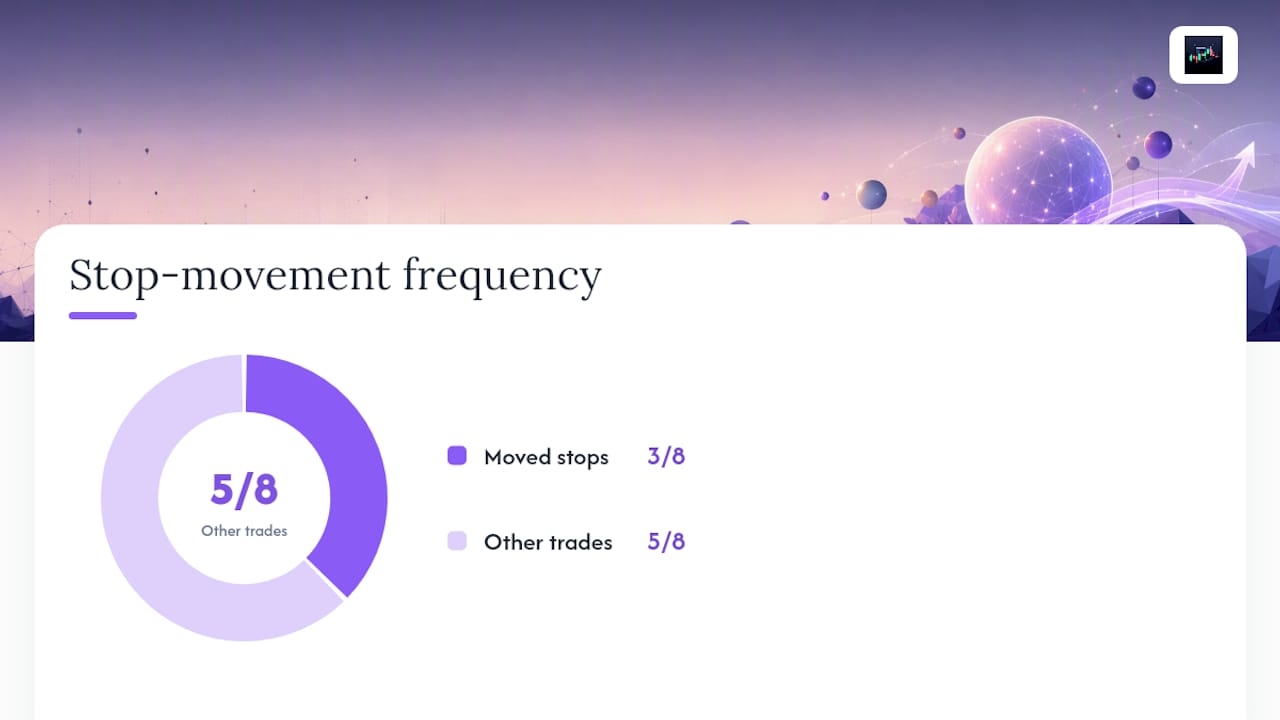
Example workflow. A crypto trader notices they’ve moved their stop three times in the past two weeks. Their AI platform detects the pattern across their journal entries and sends a behavioral flag: “Stop movement detected in 3 of your last 8 trades — average additional loss per moved stop: $340.” That number, surfaced automatically, is harder to rationalize away than a vague sense that “I need to be more disciplined.” AI tools applied to financial discipline work precisely because they make the invisible cost of bias visible in concrete terms.
For a broader view of how AI is reshaping the psychology layer of trading, the role of AI in trading psychology has expanded significantly — from pattern detection to real-time coaching prompts that fire at the moment of temptation, not after the fact.
A realistic note on changing trading behavior
Small process changes compound faster than most traders expect — and slower than most traders want. The first month of journaling behavioral flags usually feels discouraging because you’re just counting how often you break your own rules. That’s the point. You can’t fix a pattern you haven’t measured.
The traders who make the most durable progress aren’t the ones who white-knuckle their way through every temptation. They’re the ones who redesign their workflow so the disciplined choice is the path of least resistance: working stops instead of mental ones, automated journals instead of optional ones, session pauses instead of revenge trades. Loss aversion doesn’t disappear — but its ability to override your system does.
Disciplineaiapp gives you the behavioral layer your trading system is missing
Most trading platforms track what you traded. Disciplineaiapp tracks how you traded — and flags the gap between the two.

The platform’s behavioral coaching engine automatically detects loss-aversion patterns in your journal: stop movements, unplanned adds, early winner exits. When it spots a pattern, it surfaces the dollar cost of that behavior and triggers a coaching prompt or session pause before the next trade. You get AI-generated confidence scores on every setup, automated MFE/MAE tracking, and a stand-aside protection layer that enforces your daily loss limit without requiring willpower in the moment.
Three use cases where it directly counters loss aversion: intraday stop enforcement that alerts you the moment a stop is moved; automatic behavioral-flag summaries delivered after each session; and monthly performance autopsies that compare your planned exits to your actual exits in dollar terms.
Start with the Discipline AI learning center to see how the platform’s behavioral analytics and coaching tools map to the rules in this guide.
Sources
This article is general information, not a substitute for advice from a qualified financial advisor. Consult a qualified financial professional about your own circumstances before acting on anything here.
Recommended

Comments